On 5 October, Cardiff and Vale University Health Board published the terms of reference for the independent clinical review of surgical referrals from the Welsh Gender Service. For most of this year, almost everything the public knew about the service came from one source: Nick Wallis’s reporting on the excellent GenderBlog. The terms of reference confirm most of what he reported, deal with several of his concerns, and leave some important questions unanswered.
How we got here
In May, Wallis used freedom of information data to show that the Welsh Gender Service was referring patients for surgery at three to four times the UK rate per head of population. Wales has under 5% of the UK population, but it accounted for 16% of all NHS referrals for masculinising chest surgery in 2025 and 20% in 2024. He also reported that the service could not say how many of its patients it recommended for cross-sex hormones, because that information was “not centrally recorded or collated” and that an independent review of the service, ordered by the NHS Wales Joint Commissioning Committee in July 2024, had still not begun.
In August, he found an internal paper describing the service as a “potential Service of Concern”. The same paper said the long-delayed review would focus on the non-surgical parts of the pathway, while surgery referrals carried on. Days later, the Joint Commissioning Committee paused all surgical referrals, assessments and scheduled operations. Its update of 3 September noted that a markedly lower proportion of Welsh patients were going on to have surgery than patients referred from English services, which raised questions about whether some had been properly assessed for basic requirements such as overall fitness for surgery.
By mid-September, a review panel had been appointed to look at around 60 patients by Christmas. The committee reported that clinicians in NHS England had raised concerns about the “appropriateness of referrals and clinical suitability”, which was echoed in complaints from the public. The separate, long-promised review of the whole service had finally started.
What the terms of reference confirm
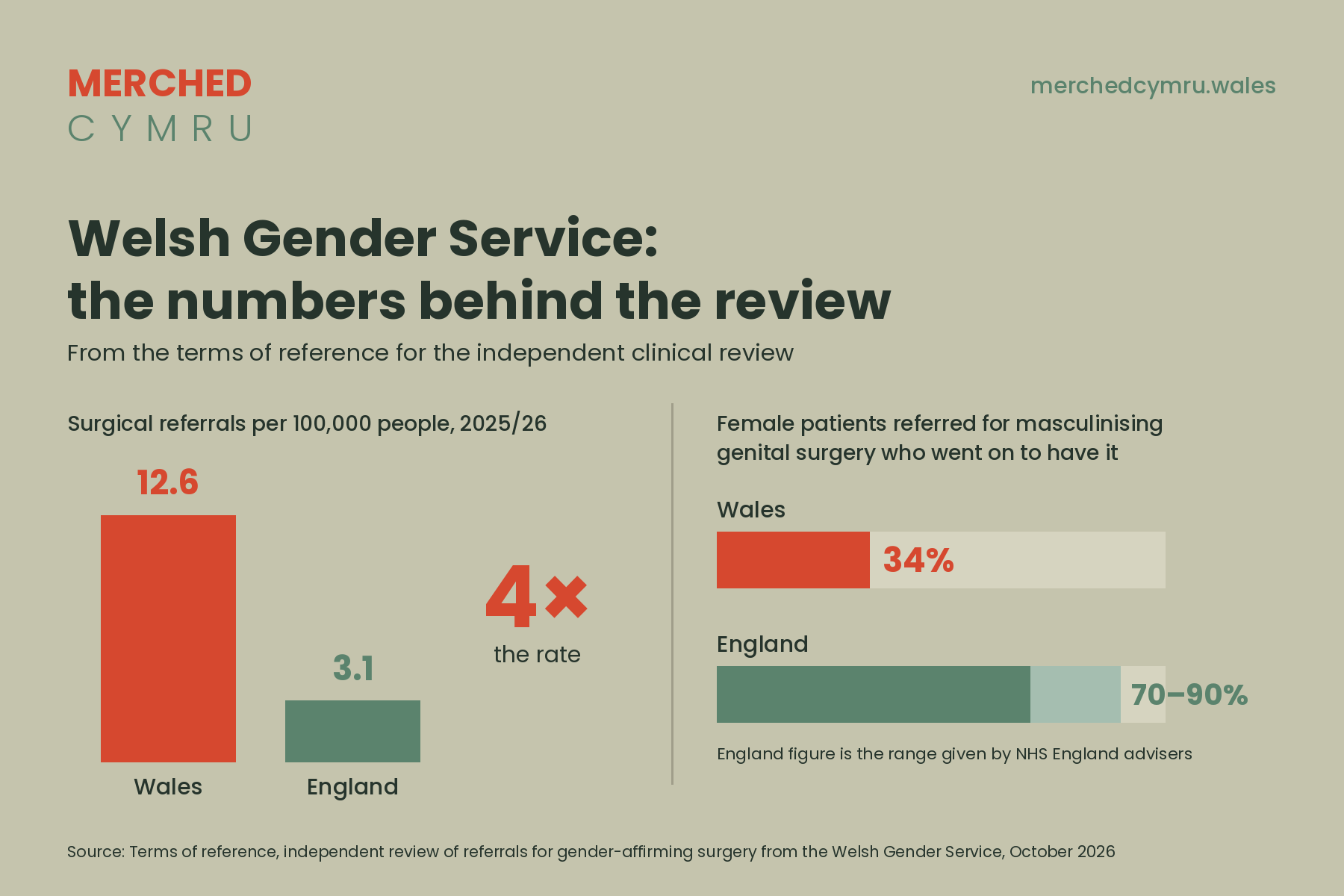
The terms of reference set out the case for the review more plainly than any official statement so far. In 2025/26, the Welsh Gender Service referred patients for surgery at 12.6 per 100,000 people, against 3.1 per 100,000 for gender services in England. That is four times higher overall, and three to five times higher depending on the procedure. The progression figure is starker still. Only 34% of female patients referred from Wales for masculinising genital surgery went on to have it, against roughly 70 to 90% for English services. The terms of reference cite “concerns expressed by clinical advisers and information arising through complaints”. They conclude that keeping the pause in place is “the safest option”.
In other words, the official account matches what Wallis reported week by week, often in the face of hostility and official silence.
Where the terms of reference meet the concerns
The terms of reference address several problems Wallis and others had raised.
Surgery is now under review. In August, the planned review was described as focusing on non-surgical aspects of the pathway. There is now a dedicated surgical review, and its findings must feed into the wider review of the service.
There is a clear standard. Each case will be judged against the NHS England service specification, using a framework agreed before any case is opened. The assessment covers mental health, physical health and, where clinically indicated, “relevant forensic or safeguarding history”. Reviewers must ask whether “wider health needs” were properly assessed – the concern raised in September.
The safeguards against a whitewash are written in. A patient being ready for surgery now does not, on its own, show that the original assessment was adequate. The absence of concerns in an initial convenience sample “should not alone be treated as assurance” about the wider service. If the first cases reviewed are not representative, more should be sampled. Urgent safety concerns are to be escalated immediately, without waiting for a report. No recommendation counts as complete until there is evidence that it has made a difference in practice.
This is a serious document, and it deserves credit for that.
The policy behind the practice
For several years, Welsh policy underpinned this pull towards medicalising issues around gender, as Ben Sears has documented in a series of pieces for Genspect.
In 2021, Welsh Government convened an Independent LGBTQ+ Expert Panel. Of its 13 members, two came from Stonewall, and one was the Welsh Gender Service’s own clinical director. The panel recommended an affirmative approach to care “in line with international clinical standards”, which its report tied to WPATH, the World Professional Association for Transgender Health. It also recommended a model led by primary care, in which GPs could start hormone treatment. It urged a “de-pathologised” approach, away from what it called the “traditional psychiatric approach” with its “intrusive and degrading questioning”. Many of these recommendations went into the Welsh Government’s 2023 LGBTQ+ Action Plan. The plan committed to cutting waiting times for the Welsh Gender Service and hormone prescriptions.
According to the “WPATH in the UK” report, drawn from the WPATH Files, the NHS Wales commissioning policy for adult non-surgical gender services referred to the WPATH Standards of Care. In May 2024, weeks after the Cass Review was published, then Health Minister, Eluned Morgan, told the Senedd that NHS Wales was working to align with its recommendations. That commitment concerned children’s services, though, and the Action Plan was never revised. In the 2026 election campaign, Plaid Cymru committed to continuing the plan and to protecting access to Welsh gender services.
A national policy that treated thorough psychological assessment as intrusive, shaped in part by the service’s own leadership, would make that medicalising gender distress more likely. The review measures the service against the NHS England specification, but Welsh policy has been asking it to work to a different standard. Whatever the reviewers find, their findings will reflect on Welsh Government’s choices as well as the WGS.
What the terms of reference don’t answer
Who are the reviewers? The document describes them only as “experienced independent gender clinicians”. Nothing is published about who they are, where they come from, or how independent they are of the practice under review. In September, Wallis pointed out that the health board had reaffirmed its commitment to “gender affirming care” before the review had even begun. Reviewers need to be independent.
Will it stop at 30? There is an interim review after 30 patients. If assurance is found at that point, the remaining stages may not go ahead. The criteria for that decision have to be agreed in advance, and the safeguards above are meant to stop a premature conclusion. But those criteria have not been published. We would like to see them.
What about hormones? Wallis reported that the service did not centrally record how many patients it recommended for cross-sex hormones. Health board figures he obtained put the monthly rate at between 51% and 88% of patients. The escalation applies only to surgical referrals. Psychological and endocrine services, including hormones, carry on as before. The surgical review will not examine them. Hormone treatments are often gateways to surgery, so any assessment problems earlier in the pathway fall to the wider service review. We need transparency to fully understand the processes.
Is the standard correct? The review asks whether referrals met the NHS England specification. It does not ask whether surgery was the right answer for these patients at all. The Cass Review found the evidence base for gender medicine weak. Some clinicians argue that a preferable goal is helping people come to terms with their sexed bodies rather than changing them. Measuring the Welsh Gender Service against the English standard is a reasonable place to start, but it does not address fundamental questions about these surgeries in the first place.
Will the reviewer be able to work without pressure? The First Minister has said he will be guided by the clinical evidence, but wants the matter resolved “quickly”. Ministers sought assurances that this was “a pause, not a stop”. Twenty-six of Plaid Cymru’s 28 backbench Members of the Senedd have written expressing “profound disappointment” at the pause, and an violent activist group has issued a warning to the commissioning committee: “Expect us.” The terms of reference ask the commissioners to confirm they have the resources to finish the job “without compromising the quality or consistency of the review”. The review needs to be conducted without activist or political pressure.
The test ahead
The original independent review was ordered in July 2024 and had not started two years later. In that time, hundreds of patients were referred for irreversible surgery. People who detransition face a heavy stigma, often including the loss of the communities that once supported them, and many never speak publicly. Wider coverage of this review may change that. If the review finds that patients were referred without proper assessment, some may decide to take legal action. Claims of that kind would be brought against Cardiff and Vale University Health Board, and larger settlements are met through the Welsh Risk Pool. In other words, they would be paid for by Welsh taxpayers. That would be the price of a Welsh Government that took two years to start a review it had ordered itself, and of a Welsh health board whose oversight missed problems that clinicians in NHS England flagged.
That is a potential cost to Wales. More serious is the potential for clinical harm to individuals who have passed through the doors of the Welsh Gender Service and may have been let down by a service whose approach put affirmation before assessment.